
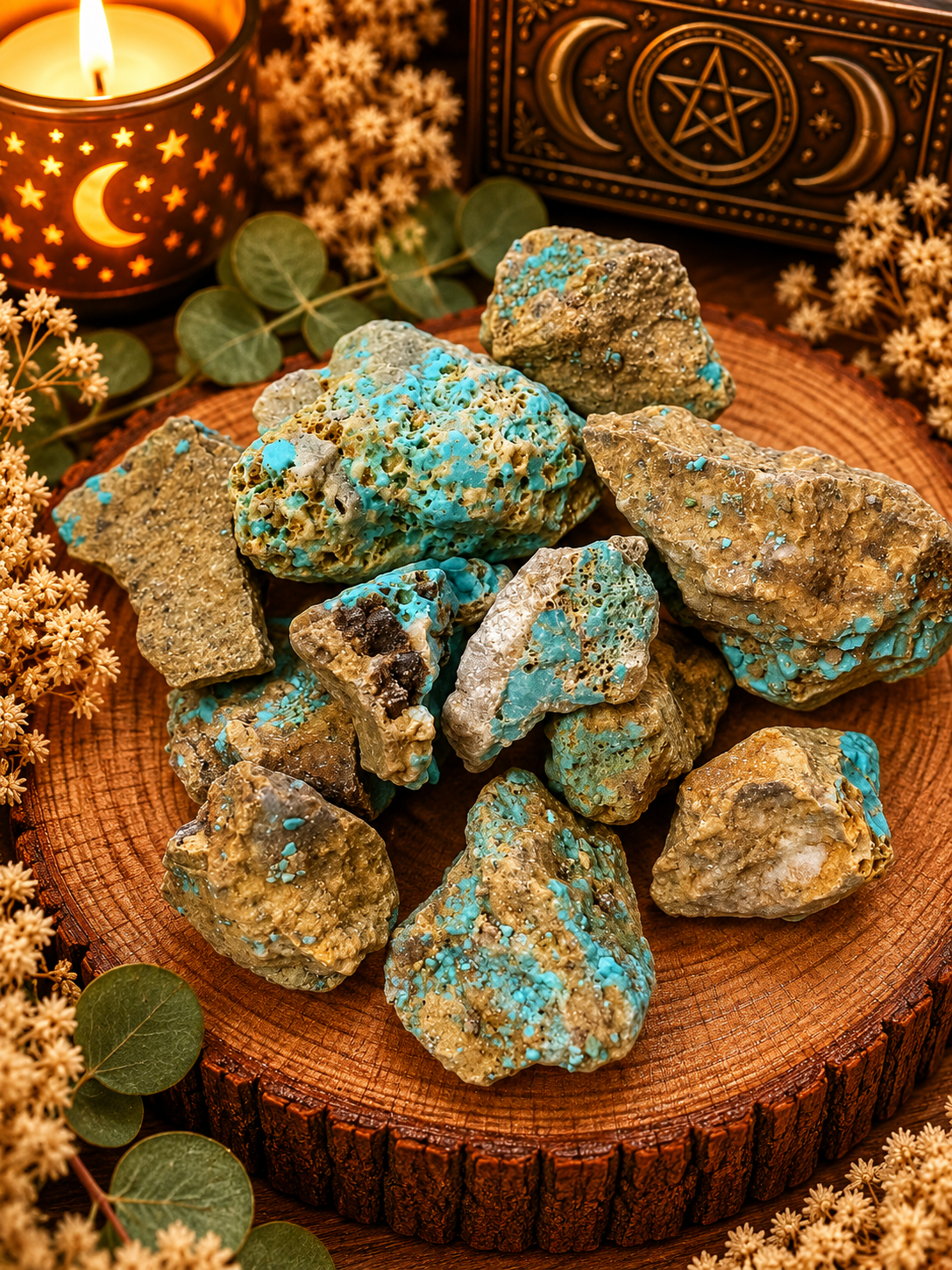
Turquoise is an ancient stone of protection, wisdom, truth, and sacred connection, treasured across civilizations for thousands of years. Its beautiful shades of blue and green have long been associated with the meeting of sky and earth, symbolizing harmony between the spiritual and physical worlds. Traditionally regarded as a talisman of good fortune, safe travels, and protection, Turquoise is believed to encourage serenity, emotional balance, and the courage to live authentically. It has held particular cultural significance in many Indigenous traditions, where its meanings and ceremonial uses vary among communities.
Closely associated with the Throat Chakra, Turquoise is believed to encourage honest communication, self-expression, and the confidence to speak one's truth. It is also connected with the Heart Chakra, particularly in its greener varieties, where it is traditionally associated with compassion, forgiveness, and emotional harmony. In energy work, Turquoise is often used to support the expression of deeply held feelings, strengthen intuition, and encourage balance between what we think, feel, and communicate. Its calming presence is especially valued during periods of change, reflection, and personal transformation.
Turquoise is a beautiful companion for meditation, protective rituals, spiritual exploration, and practices centred on communication and personal truth. It may be carried as a protective talisman, placed upon an altar to symbolize wisdom and harmony, or incorporated into intention-setting ceremonies involving courage, friendship, and authentic expression. In its raw, natural form, Turquoise offers a particularly earthy connection to the stone's origins, making it a meaningful addition to crystal grids, sacred spaces, and grounding practices. Its unpolished surfaces and natural variations invite an appreciation of the beauty found in the stone exactly as it was formed within the Earth.
Turquoise is a hydrated copper and aluminium phosphate mineral, with its distinctive blue colouring arising primarily from copper and greener tones often associated with iron. Natural specimens may display shades ranging from pale sky blue to rich blue-green, sometimes accompanied by brown, black, or golden matrix from the surrounding host rock. Raw Turquoise often has an irregular shape, a matte or earthy surface, and visible matrix, offering a very different appearance from the smooth, polished gemstones commonly used in jewellery. Turquoise is naturally porous, and its colour and surface can be affected by oils, moisture, and treatments. Its unique formations and variations make each natural specimen a beautiful expression of the Earth's artistry.
